



.png)
France vs England Tactical Analysis: Attack Won, Defence Lost
Sometimes a football match tells two stories at once. England’s 6-4 win over France in the 2026 World Cup third-place playoff was one of those games. On one hand, it was a showcase of speed, timing, movement and ruthless finishing. On the other, it was a warning about what happens when defensive structure disappears for long stretches. England were brilliant going forward, France were devastating when the game opened up, and both teams looked vulnerable whenever they had to defend large spaces.
England’s first-half dominance came from simple but powerful ideas. They attacked France before France could settle. Declan Rice’s early goal came from reading a loose moment, stepping forward aggressively and finishing from range. After that, England kept finding width and depth at the same time. Their wide players stretched France horizontally, while runners attacked the channels behind the back line. France were slow to close passing lanes and even slower to recover once England broke the first line of pressure. By half-time, England were 4-0 up, with Bukayo Saka twice punishing open grass behind the French defence.
The biggest tactical win for England was the quality of their transition play. This was not just counterattacking for the sake of speed; it was intelligent transition football. When France lost the ball, England’s first pass was usually forward, and the second movement was even better than the pass. Saka, Marcus Rashford and Eberechi Eze all attacked moments of imbalance, which meant France were constantly turning and chasing their own goal. That is the nightmare scenario for any defence, especially one whose full-backs were caught between pressing high and protecting the space behind them.
Saka was the clearest symbol of the match. His hat-trick was not just about finishing; it was about decision-making. He knew when to stay wide, when to dart inside, and when to attack the second action after an initial save or loose ball. England repeatedly used him as the release valve, and France never fully solved the problem. If one winger can receive with time, run directly at retreating defenders, and combine with midfield support, the whole defensive block starts to crack. Saka did that all night.
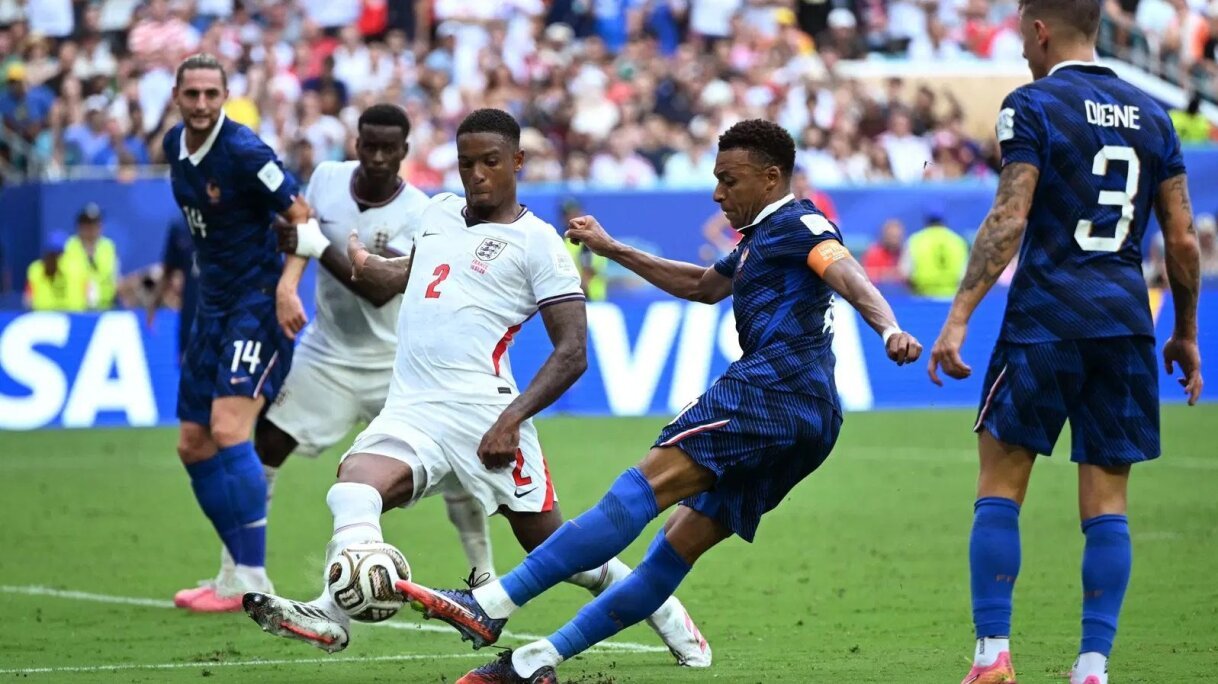
But the phrase “attack won, defence lost” applies to England too. After the break, their control vanished. France began to play through England with much more conviction, largely because Kylian Mbappé started receiving the ball earlier and in better positions. Once he could turn and drive at the defence, England’s back line looked uncertain. Bradley Barcola’s goal exposed that uncertainty further, and suddenly the match flipped from England controlling chaos to England surviving it. France’s change was not mysterious: they played faster, attacked the near side with more aggression, and committed more bodies around Mbappé.
France’s comeback also highlighted England’s defensive weakness: poor rest defence. When a team attacks, it must still be prepared for the next defensive moment. England were not. Their distances became too long, their midfield cover weakened, and the defenders were dragged into direct duels far too often. Mbappé thrives in exactly that environment. His two goals came in a game state that suited him perfectly: stretched lines, reactive defenders and broken midfield protection.
France, though, cannot escape criticism. Conceding four first-half goals was not bad luck; it was structural failure. Their press lacked coordination, their recovery runs were inconsistent, and England found space between full-back and centre-back too easily. When France pushed numbers forward later in the game, they looked dangerous. But that only made the first-half passivity more frustrating. They had the attacking quality to hurt England all along, yet they spent 45 minutes leaving themselves exposed without offering enough threat in return.
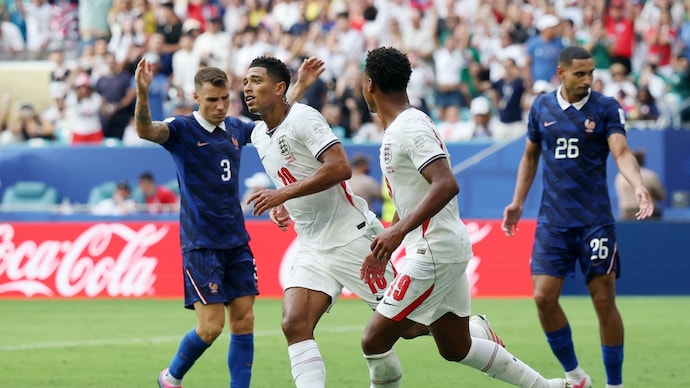
In the end, Jude Bellingham’s late solo goal closed the game, but it also summed it up. One player was still able to carry the ball through multiple defenders deep into stoppage time. That should never happen in a match at this level. England deserved the win because their attack was sharper for longer, but neither side will love the defensive film review. This was elite attacking football wrapped inside unstable team defending.
The final lesson is simple. Modern tournament football still rewards structure, but when structure breaks, attackers decide everything. England had more of those decisive moments, from Rice’s early authority to Saka’s ruthlessness and Bellingham’s final flourish. France showed enough in the second half to prove they could have won a more controlled contest. Instead, both teams turned the game into a track meet. England won it because their attack was cleaner. Both teams lost pieces of it because their defending never truly kept up.
Cover Credits Vanguard News

Leave a Reply